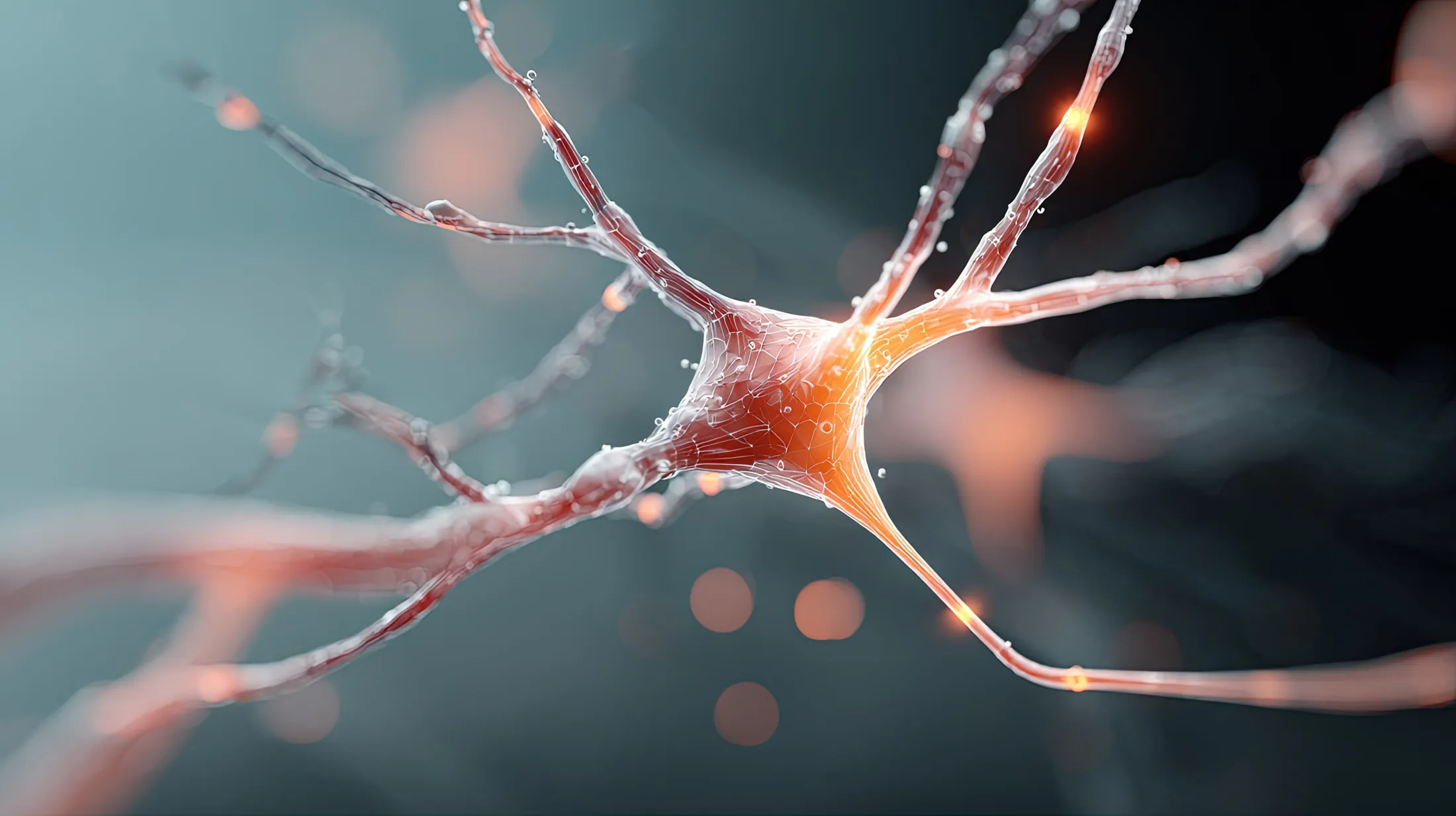
The nervous system is the hardest tissue in the body to reach with conventional therapy, and one of the most responsive when you can. Here's what the biology underneath neurological conditions looks like, what regenerative medicine targets, and what the research currently shows for the conditions we work with.
By Jed Ryan, Founder and CEO · Reviewed by Adas Darinskas, PhD, Chief Science Officer · Published · Last reviewed
Neurological conditions sit in a category by themselves. Neurons and the supporting glial cells around them follow different rules than soft tissue and bone. They regenerate poorly, communicate through long-distance signaling, and live behind a literal barrier (the blood-brain barrier) that's selectively permeable to the molecules that might help repair them. The result is a clinical space dominated by symptom management, where any therapy that can actually reach central tissue and modulate it is unusual.
We work with the following conditions in this cluster:
These look very different on paper. Underneath, they share a recognizable biological signature, and that's the level at which regenerative medicine is designed to intervene.
Whether the entry point is an infarct, a head injury, an autoimmune attack on myelin, or a slow degeneration of dopaminergic neurons, the same biological systems are typically in trouble. Mapping which ones, and to what degree, is the basis of any sensible neurological protocol.
Activated microglia and reactive astrocytes secrete pro-inflammatory cytokines (TNF-α, IL-1β, IL-6) that injure neurons and disrupt their environment. In acute injury this is short-lived. In chronic conditions, it persists.
Neurons consume an outsized share of the body's oxygen and have limited antioxidant defenses, so they accumulate oxidative damage faster than most tissue. Reactive oxygen species drive mitochondrial damage, lipid peroxidation, and protein misfolding.
The tight network of cells lining cerebral capillaries is supposed to be selectively permeable. In stroke, TBI, MS, and neurodegeneration, the BBB becomes leaky in some places and impassable to therapeutic molecules in others. Both failures contribute to disease.
The brain retains some capacity for new neuron formation (in the hippocampus and subventricular zone) and for remodeling existing connections. That capacity falls with age, inflammation, and chronic stress, narrowing the body's repertoire for repair.
Neurons are metabolically expensive. When their mitochondria fail to produce enough ATP, they can't maintain ion gradients, repair themselves, or fire reliably, and they tip toward apoptosis. Mitochondrial decline is a feature of essentially every neurodegenerative process.
Conventional neurology can address pieces of this with anti-inflammatories, antioxidant supplements, and neurotrophic medications. What it largely cannot do is reintroduce the cellular signaling that drives repair. That's the gap regenerative medicine works in.
The therapies we coordinate are chosen for their ability to reach, signal to, and support nervous tissue. Three primary mechanisms do most of the work.
Mesenchymal stem cells and the exosomes they secrete shift activated microglia and reactive astrocytes toward a repair-supportive phenotype, and rebalance peripheral T-cell populations toward regulatory subtypes. The neuroinflammatory environment changes measurably.
The MSC secretome (growth factors like BDNF, GDNF, VEGF, and NGF, plus anti-inflammatory cytokines and exosome cargo) supports surviving neurons, oligodendrocytes (which produce myelin), and the brain's own progenitor populations. The effect is global rather than targeted at any one cell.
MSC-derived exosomes, because of their size (~30–150 nm) and lipid bilayer composition, can cross the BBB and reach central tissue. Delivered intranasally, they bypass the BBB entirely via the olfactory and trigeminal pathways, reaching the brain within minutes. This is one of the few therapeutic strategies with demonstrated CNS access.
Specific peptides (Cerebrolysin, Selank, and Semax) extend these mechanisms. They support neurotrophic signaling, neurogenesis, and synaptic plasticity through pathways well-characterized in the published literature.
None of this is a cure for the underlying conditions. Regenerative medicine targets the biological signals that govern how nervous tissue inflames, repairs, and adapts. Whether shifting those signals helps a given patient is something we work out case by case.
Every protocol is designed by our medical team based on the specific condition, stage, and patient history. The four building blocks below are the ones most often used for neurological cases, and each is chosen for reasons that matter in central tissue.
An advanced class of mesenchymal stem cells with a stress-enduring property: they survive the inflammatory, hypoxic environments of injured central tissue, where conventional MSCs often die before they can work. They home to neural injury sites, secrete neurotrophic factors, and modulate the surrounding immune response.
Learn MoreStem-cell-derived nanoparticles that cross the blood-brain barrier and reach central tissue. Delivered intravenously for systemic distribution, intranasally for direct CNS access via the olfactory and trigeminal pathways. Often the centerpiece of neurological protocols precisely because of that access.
Learn MoreA defined stack of neurotrophic and neuroprotective peptides selected by case. Cerebrolysin (multi-component, IV) is well-studied in stroke and dementia. Selank and Semax (intranasal) support neurogenesis and synaptic plasticity. These extend the in-clinic cellular work into a defined-duration cycle at home.
Learn MoreNAD+ is the cofactor mitochondria need to keep producing ATP. Levels decline with age and after injury, and nervous tissue is particularly sensitive to that decline. High-dose NAD+, vitamin C, and glutathione infusions support the metabolic environment in which the cellular and exosome work has to operate.
Learn MoreThe neurological cluster is not monolithic. Evidence quality varies by condition, mechanism varies by condition, and what's reasonable to expect varies by condition. Here's where the science currently sits for each one we work with.
This is where the strongest neurological evidence sits. Peer-reviewed research has demonstrated that stress-enduring MSCs can differentiate into neurons in damaged brain tissue, extend neurites along existing neural pathways, and produce functional motor recovery in preclinical lacunar stroke models, with no tumor formation observed at ten months of follow-up.
Mechanistically, the cellular contribution layers with the secretome effect: anti-inflammatory signaling in the peri-infarct zone, reduced glial scarring, and neurotrophic support for neurons that survived the initial injury but need support to reorganize. Cerebrolysin is frequently layered in for the same reasons.
Early-phase clinical trials (Phase I and II) have shown MSC therapy is safe and well-tolerated in children, with signals of improvement in subsets of participants on standardized autism measures. The strongest mechanistic candidates currently under investigation are modulation of neuroinflammation (microglial reactivity is consistently elevated in autistic brains on imaging), gut-brain axis restoration (a growing body of work links gut immunology to CNS symptoms), and support of neurogenesis via BDNF and GDNF signaling.
The honest framing here: results are encouraging in identified subgroups, the safety profile is strong, and we coordinate cases with eyes wide open about which families are likely to see meaningful response and which aren't. We discuss expected response ranges in detail before any commitment.
An active area of investigation. Mechanistically, the targets are the surviving dopaminergic neurons in the substantia nigra (paracrine support, anti-apoptotic signaling) and the neuroinflammatory environment that accelerates their loss. MSC and exosome studies are advancing through preclinical and early-phase clinical work; intranasal exosomes are particularly compelling because of direct CNS access.
MS has a deeper clinical-trial history with MSC therapy than any other neurological condition outside stroke. The primary targets are immunomodulation (rebalancing the autoimmune attack on myelin) and oligodendrocyte support (the cells that produce and maintain myelin). Several MSC trials have shown safety and signal in progressive MS specifically. Our protocols are most relevant between flares, where the goal is preserving function and supporting remyelination rather than treating an acute episode.
Diabetic, idiopathic, and chemotherapy-induced peripheral neuropathy share underlying pathology: Schwann cell dysfunction, demyelination, axonal degeneration, and microvascular damage. MSC and exosome research in animal models has shown improvements across each of these axes. Clinical translation is earlier-stage, but the mechanistic case is strong and the patient need is severe.
Preclinical evidence indicates exosome therapy reduces neuroinflammation, supports neurogenesis, and improves functional outcomes in TBI animal models. Human clinical work is earlier-stage but advancing. For chronic post-concussive cases, where conventional rehab has plateaued, the regenerative protocol targets the persistent inflammatory and metabolic dysfunction that often underlies the symptoms.
In every case the conversation starts with what's known, what's emerging, and what reasonable expectations look like. We don't pitch outcomes. We describe mechanisms and let the evidence speak for itself.
Strong Craft Regen maintains a continuously updated repository of peer-reviewed research on regenerative medicine: the studies, mechanisms, and ongoing investigations that inform every protocol we coordinate.
Explore the Research